People participate in journal clubs or book clubs. Geek Club is my affectionate term for documenting summaries of all the geeky stuff I read. I work as a physiatrist at the East Orange VA hospital in NJ. This may also serve as a resource for the residents who rotate through there.

Friday, September 24, 2021

Phorest & Trees 09-2021


PHOREST & TREES

Like the new look? always available here.


AANEM & NEUROMUSCULAR STUFF

  • I may already have expressed my profound admiration for Ileana Howard MD in this space, but here it is again. “The Advocacy Award honors members or nonmembers who have made extraordinary contributions in advocating to government entities or insurance companies in regard to the diagnosis/treatment of NM or EDX medicine.” You go Supergirl!
  • Here is a nice review of head drop differential. I’ve already had about 5 patients with this over the years (thanks to Ileana for the link).
  • These authors propose that injected steroids (triamcinolone) in carpal tunnel work by an antifibrotic effect, suppressing collagen expression in subsynovial connective tissue fibroblasts. None of the proinflammatory IL-6, COX-2, and NF-B generes were significantly downregulated by it. Clinical eval revealed increased grip strength, EDx revealed improved SNAPs, and MRI did not reveal an antiedematous effect on synovial tissue. I thought this was a really good study.
  • Very very rare GBS after vaccine and Turns out sural sparing is still a good indicator of GBS
  • Don’t take too much laughing gas or you’ll get a neuropathy
  • Great Job Opp


MUSCULOSKELETAL / PAIN / RHEUM

TREES

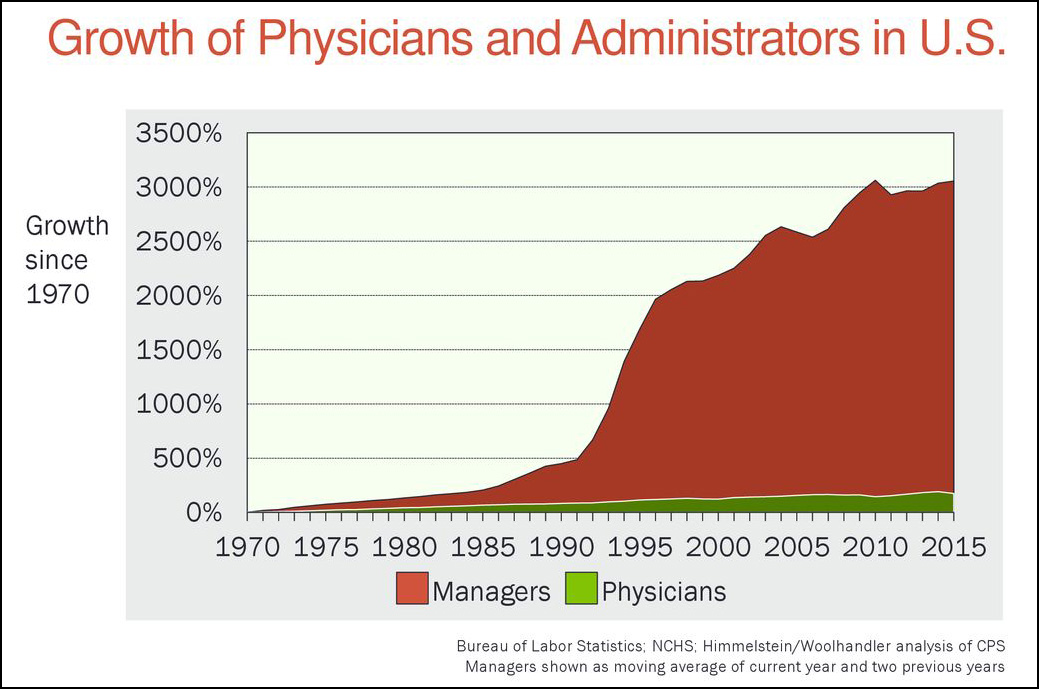
  • My reply when a friend sent this image to me: Conceptually not surprising but astonishingly dramatic when visually represented this way.  Many would argue this to be a major contributing cause to the frustrating impediments to progress and even daily operations. The response was “Amen! 2019 before Covid we spent $3.7 trillion for health care, total fed budget was $4 trillion, and 25% for "administrative costs" which was more than any other country paid per capita for their health care except France and they are rated #1 by the WHO, not 37th like us.”
  • Just disgusting
  • How much of published scientific data is fraudulent?
  • This article on how to discourage doctors is probably a sham but so well-written.
  • A discussion with Dan Pierce about the “many issues with the way the scientific process has evolved when using statistics... there is a real danger with p-hacking when there is such a strong bias to publish positive results. One way to combat this is to publish the protocol prior to performing the actual experiment. I remember talking about this salmon experiment in my statistics class – a humorous example of misapplying the p-value.”  Attached is the very funny article he’s referring to.
  • A trauma surgeon talks about night call. “I had some subconscious awareness that I wasn't using my cortical functions until I knew the relief of staying at home or the acceptance of going in. In fact, the longer the conversation would go on without knowing whether I had to go in, the tenser I got, because of the uncertainty. “Although we can all relate to this, I wonder if this is also how our patients feel when they hear a lab result or diagnosis.
  • Interesting thoughts on speaking your mind which I can understand. I wonder if this person knew how to speak his mind. The comments sections are fascinating as well.
  • 41% of americans lost confidence in their doctors during covid because of less communication. Those who had more faith attributed it to virtual care.
  • Unbelievable the administrative burdens that continue to be poured on physicians when it's the insurance companies that are the ones setting the billing rates Doc Groups Hail Decision to Delay 'Advanced EOB' Rule
  • CMS proposed changes for payment, here's AANEM's summary.
  • An interesting proposal to pay primary care
  • Using AI to prevent variation in care.
  • How medical notes will change if patients get to see them (kevinmd.com)
  • Trans women are dying faster
  • Old folks prefer texting too!

BRAIN STUFF (“abstracts only” for me)


Monday, August 16, 2021

Phorest & Trees August 2021


Phorest & Trees

It’s me birthday week…And of course the old ones here.  Hope you enjoy!

Physician Finance, Workplace Attire, Overlearning, & lotsa Jobs out there


  • I’m married to a guju JD/MBA daughter of an accountant, so lazy me didn’t bother until now. You need to understand personal finance better than I did. I found this site to be useful and I’ve vetted it for you.
  • Here’s the most recent evidence on how attire affects whether patients believe you know what you’re doing. I think this is required reading for the residents.
  • Many trainees want to do “just enough” to get it right. But there may be some benefit to overlearning
  • My friend Dr. John Norbury has joined Texas Tech University as new PMR Division Chief under Dept of Neurology. He tells of 3 positions: One is “for junior faculty, one who will be a consult/outpatient MSK physician and one will be inpatient...neurorehab would be a plus.   Both physicians would include a part time VA appointment and would have an medical education component and the ability to tailor to clinical interests or research, if desired.  They would also include public service loan forgiveness. Also, the VA here is looking for a CMO (outpatient clinic).  Great senior leadership team and beautiful brand new facility.  Having a more seasoned PM&R doc with some administrative talents in that role would be super helpful, but I'm sure any specialty which cares for veterans in the outpatient world would work.  And taxes are way less than New Jersey.“
  • Seattle VA / U Wash opportunity: “recruiting for a PM&R physician with clinical, education and also ideally research expertise in Amputee care. The position will be 100% based at VA Puget Sound in Seattle with clinical care focused on Amputee care with resident and fellow teaching responsibilities. VA Puget Sound has a large rehab focused research program and a candidate with a history of research funding and scholarly publications will find ample opportunity here for independent research and collaborations with current researchers.”
  • TBI opening in Portland Oregon VA
  • Not sure if Minneapolis VA is still looking but they wanted an amputee physiatrist too.


AANEM & EDx

  • Quantitative electromyography: Normative data in paraspinal muscles : talks about the “abnormal” findings seen in asymptomatic patients. Very similar to how we approach at the VA.
  • There was a fascinating discussion thread recently posing the question as to how much of the distal onset latency prolongation can really be attributed to axon loss in the setting of low amplitudes. (Residents should have access through the training portal. The rest of you can feel the FOMO)
  • Attached is a case of EDB pseudohypertrophy in the setting of peripheral polyneuropathy
  • Prognostic indicators for Lumbar decompression for foot drop…Duh
  • The AAN supports banning choke holds.
  • Intro and Discussion of this study on MRI findings in Statin induced myopathy are helpful for the residents. “MRI features of statin-associated anti-HMGCR myopathy can be differentiated from other types of myopathies, such as sporadic inclusion-body myositis and dermatomyositis, in terms of distribution of tissue edema and fatty infiltration. In dermatomyositis, edema is often found within the fascia and subcutaneous tissue,13 which is uncommon in anti-HMGCR myopathy. In sporadic inclusion-body myositis, fatty replacement is most prominent in the anterior thigh, with relative sparing of rectus femoris,14-16 whereas anti-HMGCR myopathy demonstrates preferential posterior compartmental fatty infiltration. On the other hand, MRI features of statin-associated anti-HMGCR myopathy may share similarities with anti–signal recognition particle (SRP) myopathy, another subclass of immune-mediated necrotizing myopathy with shared histopathological hallmarks and proposed pathogenesis.17 In anti-SRP myopathy, an anterolateral pattern of muscle edema in the anterior compartment and fatty replacement of hamstring muscle has been reported,18 but with less symmetry and more severe fatty replacement than anti-HMGCR myopathy.”

MSK & PAIN


  • Semantics are important and the spine pain community is taking a step in the right direction by reassessing the word “Failed Back Surgery Syndrome.” See attached for the letter from IASP. It’s still woefully oversimplifying if you ask me. (more on semantics in the TREES section of this email)
  • Residents may appreciate the attached brief review of Genicular nerve blocks/RFA for knee OA. Bottom line is that the literature is conflicting (esp the anatomy) but it’s an option I refer for in non-op endstage or post TKA patients.
  • I somehow still get the RIC journal club emails and two were shareworthy (hoping to discuss with Dr. Ma)
    • This 2018 ACORN study’s Intro section is excellent for R1s. The study was excellent too. I’ve included my “GMNR” on AC joint for R1s as well.
    • The attached 2021 Multicenter GRASP RCT from Lancet found a course of PT no better than a single PT best practice advice session + corticosteroid injection. If you want the details of the interventions like I did, they are found here.
  • Opioid Tapering Carries Significant Risks according to this JAMA study. There could be inherent bias as these are patients likely chosen for their risks pre-taper. I guess the take-home is to offer support while tapering. Ate
  • JAMA saying statins may not be any more likely than placebo to cause muscle aches. This was the first time I had heard of “N-of-1 clinical trials.”  See this if you are confused as well. 
  • Predictors for TFCC outcomes: above elbow splinting better than short-arm; worse with complete foveal TFCC tear and a dorsally subluxated DRUJ.
  • My father used to pay 1 dollar for each pound his obese patients lost each visit and it worked (they had to pay him a dollar for each pound they gained). Financial incentives work but should CMS pay for them?
  • Despite the possibility of responder bias, rheumatologic flare has not really been associated with COVID vaccine.
  • I only read the abstract but this may open up options for RA patients that previously had cancer.

Trees


Friday, July 23, 2021

Phorest & Trees July 2021


Phorest & Trees

Every month I share stuff I’ve been reading. This month I’ve added the new R1s and a number of alumni to the list. Those of you receiving this for the first time can access the old ones here.  Hope you enjoy!

A Bit of (Personal) Good News

Thanks to all of you for your kind words about my recent promotion to Clinical Professor. Copious gratitude to Drs. Kirshblum and Foye for their persistent tenacity, encouragement, and filling out the copious paperwork, without whom this wouldn’t have happened.  Thanks to Chae for supporting me formally and behind closed doors in ways I probably don’t even know about.

Some have asked why I bothered with this considering there are no accompanying financial benefits whatsoever attached to a non-tenure clinical promotion. I am happy to share my motivation. I did this for my dad. He was so proud of me when i got the "assistant professor" designation 15 years ago. When he passed in 2016, I decided to work toward this in his honor. So hopefully he's smiling with pride somewhere in the universe...

AANEM and EDx


On ReachMD, DOXIMITY & MedPage

Pain, Sports, MSK & Rheum

Ableism – an inherently physiatric topic to consider


Being physiatrists, we pride ourselves on being knowledgeable advocates for patients with disabilities.  This editorial tells one pediatric neurologist’s perspective and is full of clickable references to support her assertions. After diving into small but growing literature into it (only 312 references since 2006), I have some developing and conflicting thoughts on the topic which we can discuss in person. Some stuff worth sharing:


“ “[i]mmediately, and from early life and thereafter, people perceive individuals with disability as ‘vulnerable’ and of low competence, and, accordingly, treat members of this group differently.”1 Consequently, people with disabilities often continue to experience social devaluation on account of their disabilities (i.e., ableism), despite the fact that the last few decades have seen an increased awareness and a decreased social acceptability of discrimination based on other characteristics such as race (i.e., racism) and gender (i.e., sexism). People with disabilities thus remain subjected to ableist attitudes in many sectors, including — often especially — the health care system.” 


Another says

“Disability scholar Fiona Kumari Campbell defines ableism as “a network of beliefs, processes and practices that produces a particular kind of self and body (the corporeal standard) that is projected as the perfect, species-typical and therefore essential and fully human. Disability then, is cast as a diminished state of being human.”3 Campbell delineates an inherent link between this deficit-based construction of disability and a “biomedicalist stance,” which, since the Age of Reason, has “played a critical intervening role in the lives of people with disability and people with anomalous bodies or mentalities. Medicine has operated as the primary paradigm not only for the treatment of disabled bodies but has also shaped the way decision makers, legislators, families and society in general think about and sense disability.”


If you’ve done any research, you’ve probably looked at quality of life as an outcome measure. The very notion of QOL is scrutinized in this context

“At the heart of such decisions is what disability scholar Joel Reynolds has termed the “ableist conflation” of disability, suffering and death: “wherever operative, the ableist conflation flattens communication about disability to communication about pain, suffering, hardship, disadvantage, morbidity, and mortality.”


“Medicine is, at bottom, a discipline that thinks pathologically. According to a velocity of knowledge that has exponentially increased since the 18th century via scientific experimentation and technological advance, medicine functions according to the basic idea that “healthy” is “normal” and “unhealthy” is “abnormal.” The information medicine vends as truth is predicated on this distinction. In a recent piece in CMAJ, Heidi L. Janz writes that disabled people “remain subjected to ableist attitudes in many sectors, including — often especially — the health care system.”7 The reason, as Janz correctly identifies, is based in medicine’s presumption that “not normal” is the same as “unhealthy.” I wish to include ill physicians in Janz’s formulation, for the same oppressive forces medicine wields against its subjects, it also wields against itself.”


“In science, technology, engineering, and mathematics (STEM) fields, disabled people remain a significantly underrepresented part of the workforce. Recent data suggests that about 20% of undergraduates in the United States have disabilities, but representation in STEM fields is consistently lower than in the general population. Of those earning STEM degrees, only about 10% of undergraduates, 6% of graduate students, and 2% of doctoral students identify as disabled. This suggests that STEM fields have difficulty recruiting and retaining disabled students, which ultimately hurts the field, because disabled scientists bring unique problem-solving perspectives and input.” 


Even though the topic is relatively new to me to consider, there is a curriculum for medical students


Trees

  • A lecture on “Improving Interdisciplinary Gait Deviation Assessment and Treatment Plan Among Lower Limb Prosthetic Users” Direct TRAIN Link (Non-VA)
  • A lecture on Lower extremity Residual limb care: Challenges and solutions
  • We have used the iFIT socket for BKAs at the VA; they are adjustable and relatively less expensive. It was developed by Dr. Timothy Dillingham. There is now an AK version as well and I have attached the brochure.
  • A heartwarming reminder for many of us to decenter once in a while by looking for beauty.
  • Comics intersects PMR: The PUNISHER didn’t accurately represent TBI severity? No….


Wednesday, June 30, 2021

Phorest & Trees June 2021


Phorest & Trees

Enjoy the brevity because I’ve been deep reading topics for my lectures.

AANEM and EDx


On ReachMD, DOXIMITY & MedPage

Jobs

  • Graduate of our program Nicky Lacerda, MD is now the PM&R Associate Program Director at University of New Mexico in Albuquerque where she is looking to hire physiatrists (glacerda@unmmg.org  323-240-2298 cell). “Help us to build a PM&R residency program and department at the.  Clinical opportunities include electrodiagnostics, inpatient consults, neurorehabilitation/traumatic brain injury, musculoskeletal medicine and general rehabilitation. If you are passionate about physiatry, teaching and patient care, we have a place for you.     Albuquerque is a 4-season, mountain city with outdoor and cultural activities for all. Plus traffic and mosquitoes are minimal!”


MSK & Rheum

  • Congratulations to my friend Brian White, DO, an interventional physiatrist in Bassett’s PMR, for being awarded the 2020 William F. Streck Fellowship in Health Policy Management. He’s been actively fighting the good fight for years now with the Medical Society for the State of New York.
  • An interesting idea of looking at the footwear in gout.
  • An unusual reason for axillary pain

Trees


Tuesday, June 1, 2021

Phorest and Trees May 2021


Phorest & Trees

“Most people rust out due to lack of challenge. Few people rust out due to overuse” – Unknown

“I got something to say, it’s better to burn out than fade away!” – Def Leppard


On ReachMD, DOXIMITY & MedPage


Exercises do work for neck pain, knee OA, and safe in pregnancy

I know some of you still doubt it but a lower trap HEP (see attached) significantly improved pain, improved head/neck angle/posture, and increased ultrasound measurement of muscle thickness. No needles needed for neck pain?


A formal neuromuscular, weight management, self management training program of therapists led to improved implementation in Australia. This led to better patient adherence and quality of life in patients with knee OA. 74% of those who desired surgery no longer desired it 12 months later.


mild and moderate intensity exercise increases angiogenesis, but does not increase placental oxidative or endoplasmic reticulum stress in healthy pregnancies, bolstering support for routine exercise as a part of standard care in pregnant women.


Intramuscular steroids as good as intra-articular? And other oarsi stuff


EDx


Trees